
Menschen helfen sich beim Bergsteigen
Love the wind / stock adobe.com
2026-07-07 short info

How Trust Supports Standardization – Germany’s Perspective at the IEC General Meeting in Hamburg

With more than 10,000 experts, Germany represents the largest national committee within the IEC. DKE is now extending an invitation to attend the IEC General Meeting in Hamburg, which will offer ample opportunity for exchanging ideas. In an interview Michael Teigeler, managing director at DKE, elaborated on why decisions made without fear build trust, what important incentives can be created by Germany, and the role played by optimism.

Contact
Henrike Gördes

Germany is All About Hospitality

DKE: The world of electrotechnical standardization will be in Hamburg for the IEC General Meeting from November 14 to 20, 2026. As an introduction, your own personal view of the event: What should participants expect?

Teigeler: Germany represents the largest national committee within the IEC and so it has justifiably high claims. Allow me to use a bit of football jargon and say that the world will be visiting friends (Teigeler smiles, editor’s note). In 2016 we organised the IEC General Meeting, which took place then in Frankfurt. Even then we demonstrated that we not only do a good job when it comes to organising, but also know how to create an open, welcoming and hospitable atmosphere.

We aim to expand on that in Hamburg, and bring people together again for a personal exchange of ideas among experts. With its historically important role in global trade, the port city of Hamburg is particularly suited as a venue as standardization forms the basis for precisely such trade.
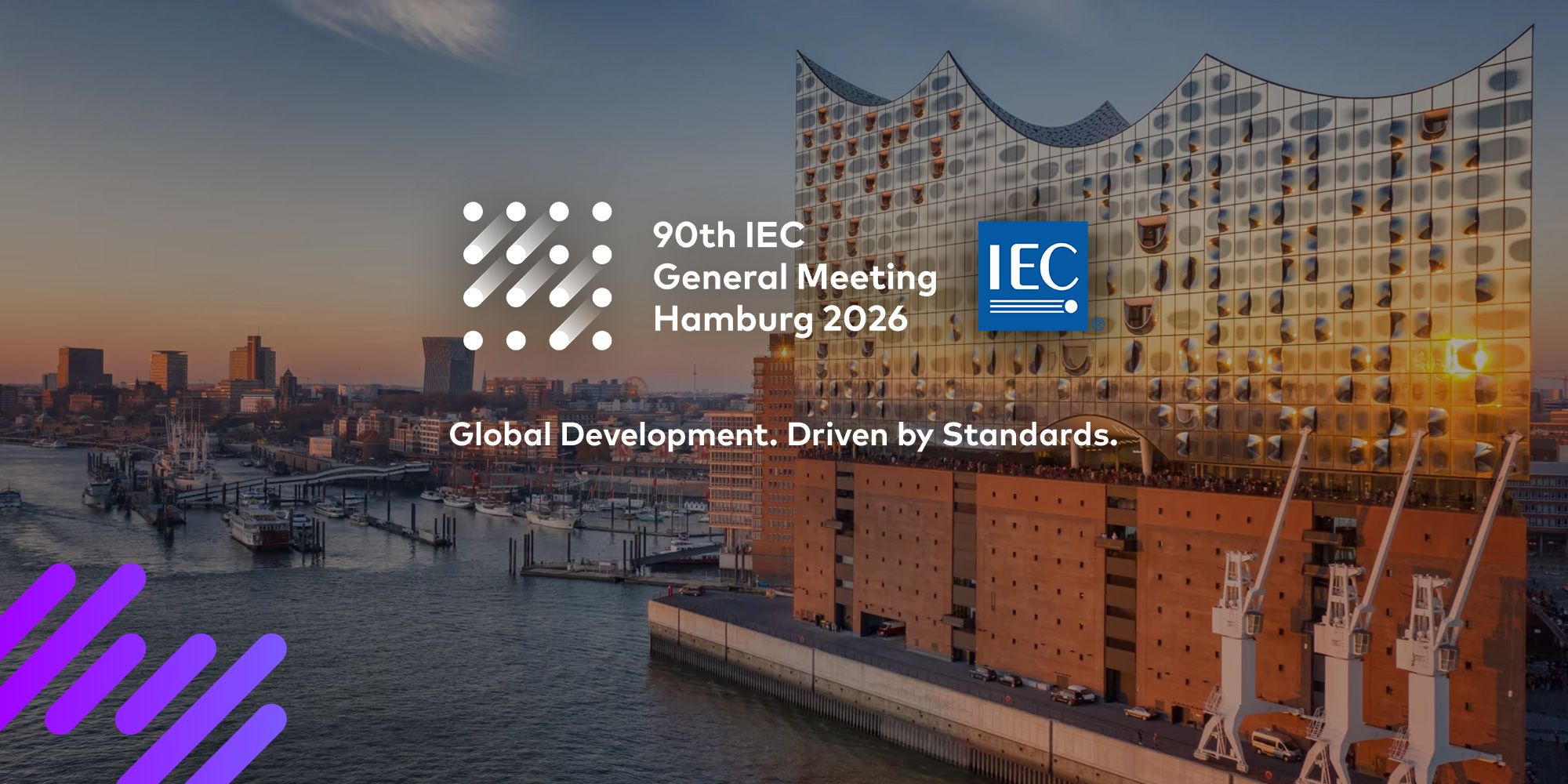

IEC General Meeting 2026

The DKE is honored to host the annual event for international electrotechnical standardization. Under the title “Global Development. Driven by Standards.”, around 3,500 guests are expected in Hamburg in November 2026.

Official Website

120 Years of IEC as a Foundation for the Future

DKE: As a result of your membership on the IEC Board, you focus on the issue of trust, one of the key topics at the IEC General Meeting. In short: How does one ensure that trust will be placed in IEC in future?

Teigeler: As a member of the Board at IEC I feel a great sense of responsibility when it comes to successfully shaping the future of the IEC together with our colleagues. We work for an organisation that looks back on 120 years of service, while being held in high esteem in the world of electrical engineering. We are in fact experiencing a veritable storm of transformation due to digitalization and artificial intelligence, one that presents us with a host of major challenges. 

My own conviction is that the knowledge that issues from our collective expertise will enable us to move forward with confidence and make decisions without fear. With a coherent vision and a healthy dose of optimism, we at IEC will continue to enjoy the world’s trust which we have garnered over the past 120 years.

Every Day Demonstrates Trust in Standardization

DKE: We often talk about the trust that various stakeholders place in standardization, but the public’s confidence in technology is also of central importance. How do you assess the current situation – is that trust still there?

Teigeler: First of all, we should be aware of the fact that every day and every application of electrical engineering demonstrates this trust. After all, innumerable standards in the background ensure safety and functionality in everyday life. Currently, more than 10,000 experts in Germany work in the field of standardization and provide for a basic trust in technology through their commitment and expertise.

Although it often appears as though Germany is falling behind, there are numerous areas in electrical engineering in which we are a driving force. Thus standardization has a positive impact on society, equal to the values that it represents. In the final analysis, we cultivate consensus, diversity and participation based on principles that are essential to trust and should be at the heart of every democracy.

A Tailwind for German Initiatives on the Subject of AI

DKE: One future technology that is making a lot of waves when it comes to trust is artificial intelligence. Standardization can help to build trust in AI and other future technologies. What kind of incentives can come from Germany?

Teigeler: With automation and Industry 4.0 Germany began very early on to introduce standards into the world of machines. This is a prerequisite when it comes to implementing standards as a way to build trust in AI applications as well. In both cases I need digitized standard content that is machine-readable and interpretable.

Through its leading role in industrial automation I see Germany in a position to provide momentum, while artificial intelligence provides a strong tailwind for what we have achieved. However, there is enormous pressure because the speed at which things are developing is breathtaking.

A final thought in this regard: Artificial intelligence is extremely manifold – it is a moving target of the highest complexity. Artificial intelligence that is trustworthy is based on trustworthy data; thus it requires appropriate code and training. In this context it is not enough to establish ethical standards – AI could in fact comply with them, but still be untrustworthy, for example, due to poor training data.


Woman in a hologram with globe

Interview with Maria Lazarte and Francis Pernel

| metamorworks - stock.adobe

SMART Solutions for Standards: Why now is the moment to act

SMART solutions for standards are no longer a future concept – they are becoming a defining factor for how standards deliver value in a digital world.

Why this shift affects the entire IEC community and why everybody now have a unique opportunity to benefit explained Maria Lazarte and Francis Pernel in our interview.

Read now

Young Talent as Part of Diversity

DKE: What is the situation in Germany with regard to social participation and diversity in standardization?

Teigeler: As I mentioned earlier, we have more than 10,000 experts working in standardization and thus a very large base in terms of human resources. Diversity is comprised of various factors: the involvement of as many disciplines and qualifications as possible, the empowerment women, and the recruitment of young talent. I helped to launch Next Generation DKE because this aspect is very important to me. This also served to inspire IEC, which now has a similar initiative of its own. Thus we’ve already come a long way, although a look toward China reveals that a lot can still be done. There they have various courses of studies that are focused on standardization.

Working toward the Future with a Positive Attitude

DKE: Trust is imperative if the IEC is to remain the authority on electrotechnical standardization in future. As the host of the General Meeting in Hamburg, how does DKE intend to make a contribution in this regard?

Teigeler: In my opinion, standardization is most trustworthy and successful when the process brings all stakeholders together. An event like the General Meeting also creates an opportunity to promote exchange between different Technical Committees. And that is why we did not want to say which Technical Committees would be allowed to attend and which would not, as such a decision is very difficult to make.

The result is a General Meeting with around 3,000 experts from around the world who will be given a platform in order to find joint solutions for a wide variety of issues. There will also be an accompanying programme that will hopefully provide for pleasant memories of our shared experiences. This is the spirit that will carry us into the future – it is one that online meetings cannot replace.


Logo Next Generation DKE
DKE

Become part of the Next Generation DKE!

Working in standardization offers newcomers in particular a large network with many international contacts and career opportunities as well as opportunities for professional exchange. If you want to get involved in the Next Generation DKE, the DKE provides a wide range of support, e.g. by enabling you to participate in high-caliber events such as the IEC General Meeting.

Read more

“Show how much good there is in our country”

DKE: And finally, your own perspective: What are you looking forward to most when you think about the IEC General Meeting in Hamburg?

Teigeler: The fact that so many colleagues have accepted our invitation confirms my belief that we are on the right track, even if organising it is quite demanding due to the large number of participants. With its unique flair, Hamburg will be a wonderful venue and so I am looking forward to a very special event and to seeing many of my colleagues again. I grew up in the world of standardization, and so I am happy that everyone will get together here in Germany. To some extent the General Meeting is also an opportunity to show how much good there is in our country, despite all the negative news: Within the bounds of the IEC, Germany is shaping the future, and with this basic optimism we should look ahead and get to work.

The interview was conducted with:

Michael Teigeler

Michael Teigeler is Deputy Managing Director at DKE and is particularly responsible for the strategic direction of German electrotechnical standardization internationally and in Europe. In this role he represents the DKE at the international level on the IEC Board and in the ISO/IEC Joint Standing Committee (JSC), and contributes German perspectives to international standardization work.


Icon book
VDE

Basics of standardization: explained briefly and clearly

To understand the principles and fundamentals of standardization, you only need to know a few things. The basics include definitions, basic terms and explanations of processes and objectives, as well as further information on norms and standards.

Read more

Relevant news and information about standards