
Two people shake hands
hao / stock.adobe.com
2026-04-24 expert contribution

Standards in a fragmented world: Hamburg as a platform for enhanced dialogue between standardization and regulation

We are living in a time of significant technological and geopolitical shifts that are having a profound impact on the relationship between standardization and regulation. The 2026 IEC General Meeting in Hamburg, will bring together the relevant stakeholders and outline the future of technical standards.

Contact
Johannes Koch
Related VDE Topics
Spiteller and Metzger are sitting opposite each other at the table

Philippe Metzger and Florian Spiteller in conversation

| DKE

Philippe Metzger (IEC Secretary-General & CEO) and Florian Spiteller (member of the DKE Executive Board and of the IEC Standardization Management Board (SMB)) explain why the interplay between standardization and regulation provides competitive advantages, to what extent policymakers benefit from digital standardization processes, and what to expect from the General Meeting.

DKE: Why is the IEC General Meeting in Hamburg the perfect opportunity to bring together regulatory authorities and the standards community?

Metzger: I believe several factors are at play here. We are currently witnessing extraordinarily rapid technological development. AI, energy systems, automation, and many other technologies are advancing at an ever-faster pace and becoming increasingly interconnected. In this environment, the demands on both standardization and regulation are growing. The dialogue between regulation and standardization is therefore becoming increasingly important and challenging. This requires a strong platform. 

The IEC General Meeting in Hamburg offers exactly that platform, bringing together thousands of experts from all over the world. Thanks to the hospitality of the German National Committee, we can create a unique meeting point to discuss innovations, the technological ecosystem, and dive into normative and regulatory issues.  Last but not least, known as the “Gateway to the World”, Hamburg is the ideal place for this dialogue.

Spiteller: Thank you very much! We are looking forward to welcoming the world to Hamburg. What makes the General Meeting special to me is the diversity of our IEC community. In Germany, we work in a public-private partnership that bridges standardization and regulation. Other countries organize it differently, each with its own strengths. In my view, the IEC has done a good job of bringing these different systems together and collaborating to develop international standards. We can also see that the influence of regulation is increasing: for example, in Europe through new initiatives and political developments. This makes it all the more important to intensify the dialogue and work together on how we can further strengthen our collaboration.
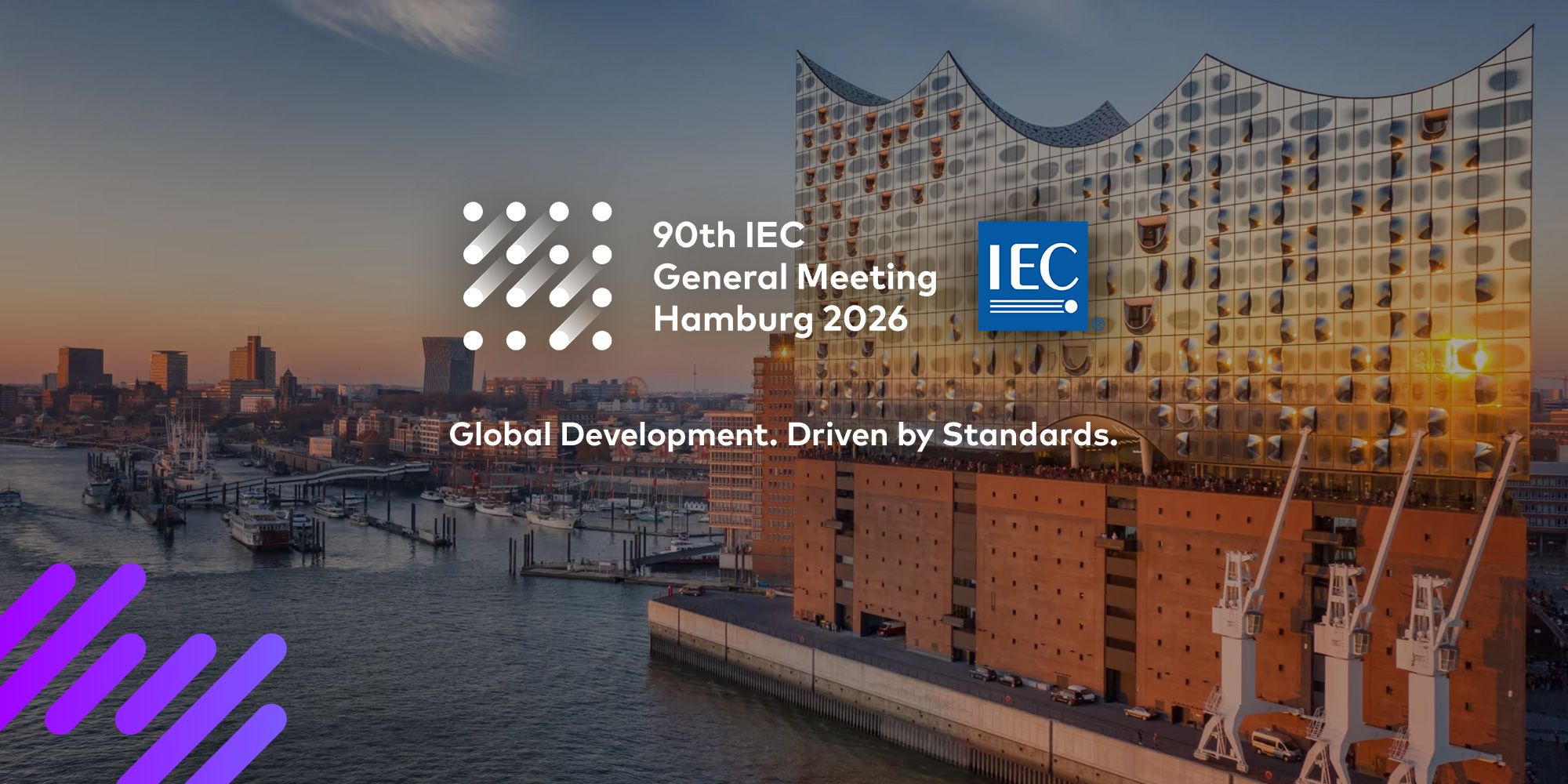


IEC General Meeting 2026

The DKE is honored to host the annual event for international electrotechnical standardization. Under the title “Global Development. Driven by Standards.”, around 3,500 guests are expected in Hamburg in November 2026.

Official Website

One world, many rules - one common thread

DKE: The interaction between regulation and standardization differs in global markets. How can the IEC coordinate these different approaches?

Metzger: There are government-organized standardization systems, public-private models, and purely private-sector structures. These differences depend on national governance systems, and that is entirely legitimate. What we can offer together with our national committees is a common framework: transparent, inclusive processes, as well as thousands of international standards and globally recognized conformity assessments. These uniform and transparent processes are at the core of our identity and our unique selling point. They build trust, especially in heterogeneous markets.

At the same time, standards relieve the pressure on lawmakers. A regulator seeking to solve a complex technical problem will be grateful for an internationally agreed, transparently developed standard that is recognized worldwide. This significantly simplifies regulation and fosters innovation.

Of course, there are always specifics to consider at national level, such as geographic or climatic conditions. The IEC does not prevent any country from making specific adjustments. Our tools such as the Global Relevance Toolbox help to illustrate national variations transparently, without losing sight of the international framework. This creates a global platform where common solutions are possible despite different systems.

IEC Global Relevance Toolbox

How can you make standards relevant for all countries?

International standards represent the collective expertise of representatives from across the world. However, countries may also want to adapt standards to unique needs in their region. 

Within global standardization processes, regional specifics relating to climate, regulation or infrastructure may need to be taken into account. The IEC Global Relevance Toolbox (GRT) supports this process by helping experts determine when and how to add normative or informative content to existing standards or new work. The objective is to maintain the global applicability and acceptance of standards despite local variances. It helps document deviations transparently while staying aligned with the international baseline. This further supports a truly global platform that works for everyone, despite differing systems.

IEC YouTube-Video on the Global Relevance Toolbox

Cooperation as a global competitive advantage

DKE: In which areas can coordination between standardization and regulation lead to better outcomes?

Spiteller: Quality is one of the key objectives of standardization. At the same time, however, quality must not be compromised in the interest of speed, as time-to-market is crucial for users of standards. This presents a significant opportunity. If regulators and standard developers communicate their expectations at an early stage, then quality and speed can be more easily aligned.

Moreover, as Philippe has already said, standardization can ease the burden on regulators. A good example of this is protection against electric shock. The law merely stipulates in general terms that electrical devices and installations must be safe. Full stop. However, it does not describe how to achieve this safety. This is where electrotechnical standards come in. They specify, for example, which protective measures are necessary, which residual current devices need to be employed and how cables must be installed to ensure that no one suffers an electric shock in everyday life. Therefore, while the state defines the objective, standardization describes the technical path to achieving it in a quick and flexible manner, always according to the state of the art. 

In addition, Germany is pursuing a clear strategy of focusing on international standards rather than developing national exceptions. Ideally, the unmodified versions of IEC standards should be adopted by as many countries as possible, leading to global acceptance and ideally, combined with globally recognized testing procedures.


International container cargo ship in the ocean
enanuchit / stock.adobe.com

Conformity Assessment – the Free Flow of Goods Worldwide

The term “conformity assessment” is widely known – yet it is oftentimes quite intangible. Conformity assessment essentially provides for the free flow of goods within one or more markets around the world. Numerous national laws as well as international guidelines and regulations are employed in order to assess goods, processes, and services. In addition, the requirements of conformity assessment procedures vary in different industries – such as the toy industry, medical technology, or electrical engineering. Our technical article on conformity assessment summarises the key points and provides answers to frequently asked questions.

Read more

Standards provide a turbo boost for digitalization - for the benefit of political regulation

DKE: Standardization is moving towards digital, machine-readable standardization content. What are the benefits for regulatory bodies?

Metzger: The digitalization and machine readability of standards offer a range of benefits. For businesses, this means integrating standards efficiently into production processes. Where a standard is referenced in regulations or incorporated into legislation, its automated implementation can help businesses incorporate regulatory requirements directly into their processes.

This benefits regulatory bodies, as testing and inspection processes can become more efficient, transparent, and accessible. Automated processes reduce time-consuming coordination. Furthermore, our experience as citizens shows that the more digitally the public sector operates, the easier it is to deal with government bodies. Machine-readable standards can improve interoperability between IT systems and facilitate the exchange of information between public authorities, the business sectors and society. A complete automation of these interactions at the touch of a button would be unrealistic. Increased efficiency and accelerated processes, however, are both desirable and realistic.

Spiteller: One good example is the German initiative QI Digital, which is focused on the digitalization of the national quality infrastructure. This infrastructure encompasses metrology, standardization, conformity assessment, accreditation, and market surveillance. The digitalization of these areas will lead to substantial efficiency gains. We aim to bring the relevant stakeholders together in Hamburg. 


Digitaler Produktpass
pickup / stock.adobe.com

Digital product passport: digitalization and circular economy through standardized data

Digitalization is here to stay. In the world of industrial production, this was recognized early on, resulting in numerous developments being driven forward, including at a normative level. One manifestation of this is the digital product passport, which uses digital and standardized information to take the next step and support the industrial circular economy in the long term.

Read More

The IEC system offers stability even in turbulent times

DKE: How should the international governance of standardization evolve in the face of geopolitical changes?

Spiteller: In the past, it was often said that standardization was purely technical, not political. This still holds true. However, it is also undeniable that political developments have an influence on international cooperation. The question is: Do we therefore need to change the approach to governance? Or how can we demonstrate that our system is robust? In my opinion, governance has proven its robustness. Political challenges will always affect standardization, but they will not cause the system to fail. It is important to reflect on and discuss these developments.

Unfortunately, some countries have temporarily withdrawn for political reasons. This makes personal interaction even more important. General Meetings therefore offer an indispensable platform – not only in official sessions, but also in informal discussions. Mutual understanding is particularly important in a tense global climate.

Metzger: When we talk about geopolitics, the issue of fragmentation is what stands out most to me. For 120 years, the IEC has been a leading non-political, technical organization. Even in times of major geopolitical tensions, it has retained its value because it has consistently focused on its core mission. Whilst a certain degree of fragmentation can be observed, the use of, and need for, our standards is not declining, quite to the contrary. 

The key lies in bridging fragmentation through compelling, indispensable standards: not legally binding per se, but technically so compelling that there is no alternative to them. If we continue to deliver substantial, technologically compelling solutions, the world will keep turning to us, even in a fragmented world.

Spiteller: Yes, international standardization is particularly important, especially in times of fragmentation. When technical developments are based on different standards, barriers arise that are difficult to overcome later on. That is why we must stick to common technical foundations, despite political tensions. An international IEC standard remains the best basis for overcoming fragmentation in the long term.

Seize the Hamburg moment: a chance to demonstrate global solidarity

DKE: What would be the best outcome from the IEC General Meeting 2026 for you?

Metzger: The meeting in Hamburg is an opportunity to build solutions. It will be attended by thousands of delegates with different priorities, but what unites them is a shared commitment to working together. From my point of view, this signals a need and a desire for greater international cooperation, which is already a significant and positive outcome. 

Moreover, I am looking forward to seeing developments in the digitalization and machine readability of standards, in addition to the engaging discussions around progress across different sectors. This is a moment to show how the world of standards is taking us into the future.

Spiteller: I would like to see us kick-start a new dialogue between regulation and standardization, and for this dialogue to be sustained over the long term and bear fruit.


Brandenburg Gate in Berlin
TTstudio - Fotolia

Standardization and policy

Standardization policy-related action is what makes the development process of standards and specifications possible in the first place. Its purpose is to disseminate, improve and fully demonstrate the extensive benefits of standards and specifications for society, economy, science and state.

Read more

News on policy, law and strategy in standardization