building illuminated in green
Matthias / stock.adobe.com
2026-05-27 expert contribution

Data centers in transition: Higher performance, higher efficiency, higher responsibility

Modern data centers are on the verge of a major step: growing processing loads, increasingly compacted technology, and rising expectations regarding climate protection.

In Germany, regulations such as the Energy Efficiency Act define clear requirements for waste heat utilization. In Europe, the EN 50600 standard series gives common criteria regarding construction, operation, and key performance indicators. On an international level, alignment with ISO/IEC standards ensures comparability.

Data center operators no longer plan only server rooms but energy-efficient infrastructures with reliable operation and intelligent heat utilization that are also suitable for urban environments.

Contact
Dr. Tim Brückmann

Higher performance per rack changes rules

A rack is a cabinet for servers and network equipment. In the past, a rack often consumed merely 0.5 to 1 kilowatt of electricity. Today, many systems use between 8 kW and 10 kW per rack. In the near future, individual racks are likely to reach values of up to 100 kW. These figures indicate that the future will see much higher numbers of much more powerful devices operating within the same space than ever before.

This has a direct impact on planning: Busbar systems and uninterruptible power supplies are required to safely handle and distribute higher loads. Safety, maintenance, and load management will become increasingly important as reserves are shrinking faster. Sensors measure the performance, temperature, and airflow. Continuous monitoring detects early on when the system reaches its thresholds. This allows the timely planning of conversions and the avoidance of hotspots.

The common separation into cold and hot aisles alone will no longer suffice. Higher densities require closely coordinated electrical distribution, short energy pathways, and clearly defined measurement and alarm thresholds. These are prerequisites for reliably increasing the performance.

Air cooling reaches physical limits

For decades, data centers used air cooling via raised floors. Fans fed cold air into the front of the racks and warm air flowed out at their back. This principle reaches its limits at a power consumption of approximately 10 kilowatt per rack. Beyond that value, the air volume would have to be increased to such an extent that the power consumption of the fans themselves would rise too high and the air pathways would become overloaded.

These limits exist because air transports the heat rather slowly. A suitable comparison would be a fan working against the heat of an oven: despite moving a lot of air, the heat will remain. In data centers, more airflow does not automatically lead to more cooling. The fans consume more power, generate noise, and encounter obstacles in tightly arranged racks. Consequently, reserves will run low, and temperatures will rise faster.

Therefore a different cooling medium is taking center stage: one which transports heat significantly better and opens up new opportunities.

Water cooling creates flexibility and reduces risks

Water absorbs heat much faster than air. In a data center, this means stable temperatures and lower energy consumption when operating fans. Systems run more quietly, and high power densities can be safely planned. Simultaneously, the dissipated heat is available at a temperature at which it can be effectively utilized for buildings and municipalities. Water cooling thus becomes a key component for future operations and the energy transition.

There are two possible options:

  • Indirect water cooling: Water flows through heat exchangers positioned close to the rack. It cools the air locally and dissipates the heat.
  • Direct water cooling: Water flows in very close proximity to the processors, sometimes right up to the component. This reduces temperature peaks and required fan performance.

These systems usually operate as a closed loop. The water does not evaporate but remains in the system. The need for refilling remains low. Tightness, monitoring, and clearly defined maintenance processes are crucial.


IEC General Meeting 2026

The DKE is honored to host the annual event for international electrotechnical standardization. Under the title “Global Development. Driven by Standards.”, around 3,500 guests are expected in Hamburg in November 2026.

Official Website

Conversion of existing systems: Clear steps, smooth operation

Many data centers have been operating reliably for years. Therefore in-service conversions feel, figuratively speaking, like a house being refurbished while people are still living in it. Everything has to remain functioning while numerous changes take place. Therefore, a clearly defined plan is crucial. Each phase ensures stable operation and smooth running of all systems:

  • Check routing paths: Where can new pipes be installed without impairing escape routes, fire safety measures, and maintenance areas?
  • Adjust cooling capacity: Are the capacity, the supply and return temperatures, and the redundancy of the chillers adequate?
  • Ensure water quality: Plan ahead for corrosion protection, filters, sensors, and leak detectors.
  • Avoid operational downtimes: Combine conversion works within maintenance windows, temporarily redistribute loads, define rollback procedures.
  • Documentation and training: Update plans, train staff, test alarms.

Step by step, a system is created which keeps operations stable, provides higher performance, and is better prepared for future requirements.

Utilizing waste heat: Heat becomes a product

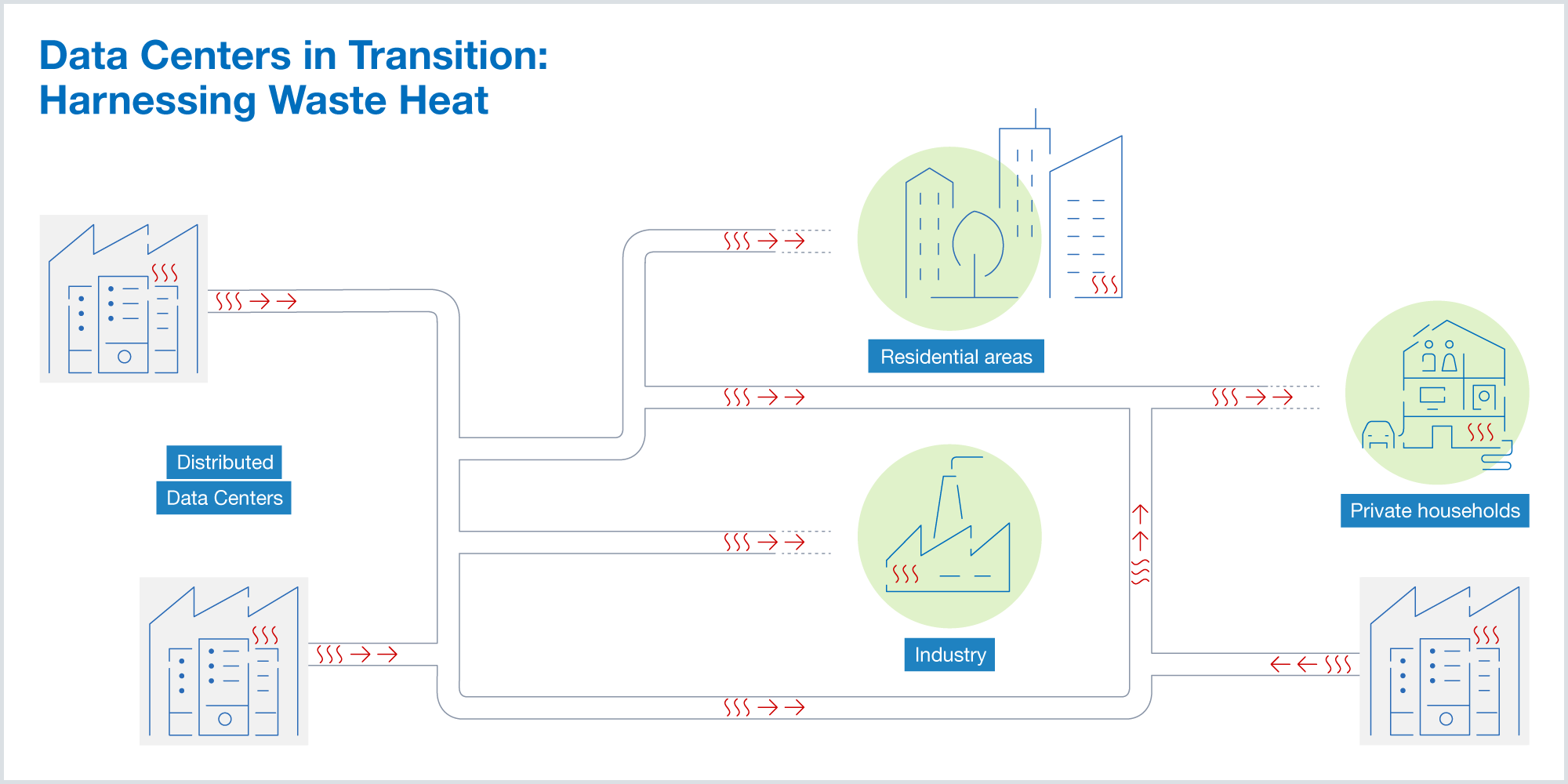
The German Energy Efficiency Act (EnEfG) of November 18, 2023 establishes a cross-sectoral legal framework for increasing energy efficiency in Germany. It is used to reduce energy consumption, increase security of supply, and strengthen climate protection by reducing greenhouse gas emissions. The EnEfG specifically addresses the utilization of waste heat from data centers using electrical energy and emitting heat. With water cooling, this heat is available at convenient temperatures. Buildings, municipalities, or commercial facilities can be supplied with it.

Waste heat thus creates a threefold benefit: It reduces emissions, saves energy, and strengthens municipalities. These benefits arise primarily where there is demand in the immediate vicinity. So the first step is a joint assessment of the surrounding area: Who in this vicinity needs heat and when? Or asked differently: Why transport heat over long distances when a residential area or a school is located nearby? In cities and densely populated areas, heat consumers are often easier to find.

At this exact point, decentralized structures come into play: Several suitable locations instead of a single large complex. Proximity reduces costs and losses and strengthens trust in this technology. A factor not to be underestimated when the acceptance of construction measures is concerned. An example from everyday life illustrates this concept: Instead of building a giant parking garage on the outskirts of town, several smaller parking garages are built within city limits. People park closer to their destination. Traffic flow improves. In the context of data centers, this means shorter data paths, many heat-related opportunities, and greater operational flexibility.

A smart choice of location is therefore essential – for both operators and local authorities. Operators should start the dialog with municipal utilities and local heat planning authorities at the early stages of planning a heat network as it requires time: Planning, permission, and construction are often time-consuming processes in Germany. Through good planning, data centers can be usefully integrated into local heat planning for the long term. Thereby, their waste heat becomes usable for citizens instead of escaping unused.

Data Centers in Transition: Harnessing Waste Heat

Data Centers in Transition: Harnessing Waste Heat

| DKE

Standardization provides guidance: Check maturity, plan measures

Standards create a common foundation. They provide clear language, transparent criteria, and reliable verifications. This facilitates collaboration and accelerates decision-making in projects where many stakeholders are involved: data center operators, planners, municipal utilities, network operators, and authorities. All parties pull in the same direction using the same terminology and sharing the same goals.

The European standard series EN 50600, “Information technology — Data center facilities and infrastructures”, for example, combines the requirements for data centers over their entire lifecycle – from concept to operation. While Part 1 describes general concepts, Parts 2–x address construction, power supply and distribution, telecommunications cabling infrastructure, and physical security. Part 3-1 sets out the rules for management and operations. Parts 4-x introduce key performance indicators that can be used for measuring and reporting sustainability factors. This provides a consistent framework connecting technology, organization, and reporting throughout Europe.

The Data Center Maturity Model (DCMM) provides support during implementation. It starts with a concise status report, organizes fields of action, and prioritizes steps to safeguard operations. Simultaneously, CLC/TS 50600-5-1 provides an EU-standardized evaluation approach that describes maturity levels for environmental and resource-related aspects. This is how the standard becomes a practical pathway: From evaluation to roadmap – step by step.

The practical benefits of the European standard series EN 50600 and the Data Center Maturity Model are evident in everyday operations: EN 50600 structures risks, availability targets, and efficiency requirements, making them verifiable. DCMM results facilitate the dialog with municipal utilities and local authorities and can be incorporated into tenders, contracts, and audits – allowing goals to be measured, controlled and verified.

For example, payments go towards recognized eco-labels such as the Blue Angel for data centers. This label defines threshold values and requirements closely aligned with efficiency and responsible operations. It is awarded to data centers that are operated in a particularly energy-efficient and resource-conserving manner. New builds are the primary beneficiaries. Planners incorporate the criteria from the start and avoid later retrofitting. Existing systems catch up gradually by means of due conversions.

Standardization links technical development to governance and verification. One image makes it clear: Standards are both the map and the key. They lead the way, and everybody reads the same signs. This saves time, avoids detours, and builds trust.


Outlook: Data centers as a key component of local energy and heating planning

Data centers process data. Simultaneously, they generate heat. Both are closely linked. Operators therefore focus not only on servers, but also on piping, heat pumps, and heat exchange stations. They build partnerships with grid operators, municipal utilities, and local authorities. This creates a system which provides performance and conserves resources.

The coming years will see higher loads, denser racks, and more water cooling. Those who plan early will keep temperatures and risks under control. Those who utilize the heat will strengthen the municipalities.

And those who incorporate standards will make the right decisions. This is how change becomes success.


Interested in additional content about Home & Building?

Home & Building
DKE

Home & Building focuses on the integration and use of information and telecommunications technologies in the home environment, which open up new experiences and make familiar activities related to entertainment, comfort, energy management, security, and health more cost-effective or convenient. For more information on this field, please visit the

DKE area of work Home & Building

Relevant news and information about standards